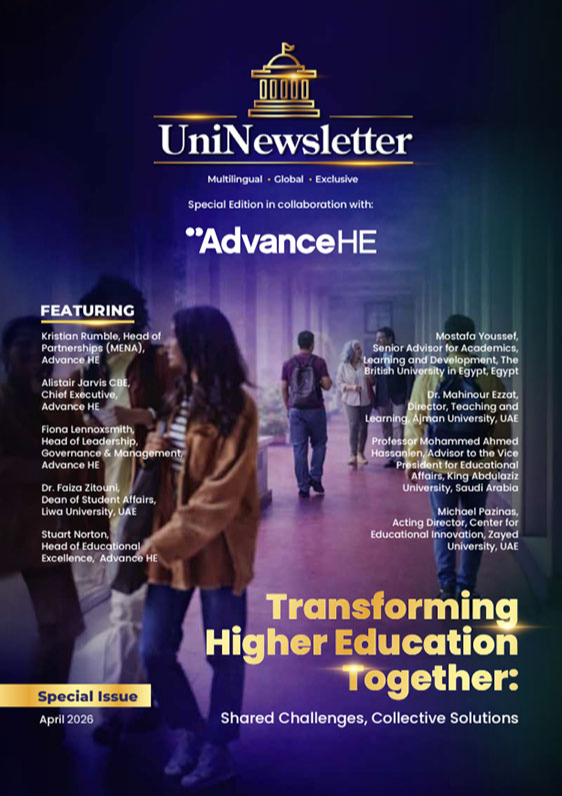
Published on May 2026
Share
Alistair Jarvis CBE Chief Executive Advance HE
Over recent months, I’ve had the privilege of visiting higher education institutions across several continents—from the Gulf states to Ireland, and from Europe to Australia. These visits have reinforced something I’ve long believed: while the contexts in which we work may differ, the fundamental challenges facing higher education are remarkably consistent across borders.
The Common Ground
Whether in Dublin, Dubai or Darwin, universities are grappling with similar pressures. Funding models designed for a different era are straining under the weight of expanded participation. Student expectations around flexibility, employability and support have evolved faster than many of our systems. The rapid advance of artificial intelligence (AI) is raising profound questions about what and how we teach. And geopolitical tensions are complicating the international partnerships that have enriched our sector for decades.
During my recent visits, I was struck by how candidly colleagues discussed these challenges across such diverse contexts. There was no pretense that any institution or region has all the answers. Instead, there was a refreshing openness to learning from one another’s experiences—both successes and setbacks.
What’s Working
Some of the most promising developments I’ve observed aren’t dramatic reinventions but rather thoughtful adaptations. Digital learning platforms are being deployed not to replace face-to-face teaching, but to enhance it and extend access to those who might otherwise be excluded. Partnerships with employers are evolving beyond traditional placement schemes into genuine co-design of curricula that better serve graduate outcomes and economic needs.
Institutions are also reconsidering their governance structures, seeking the agility to respond to rapid change whilst maintaining academic integrity. From Melbourne to Manchester, universities have created clearer pathways for staff development, recognizing that organizational change depends ultimately on people’s capacity to lead and adapt.
Across different contexts, there’s growing recognition that inclusion isn’t simply a moral imperative but a practical one. When universities reflect and serve their diverse communities more effectively, outcomes improve and reputation strengthens.
Questions We’re All Asking
Yet honest conversations also reveal persistent uncertainties. How do we balance financial sustainability with our core educational mission? How do we prepare students for careers that don’t yet exist? How do we maintain quality whilst expanding access? How do we preserve institutional autonomy while responding to legitimate external expectations?
These aren’t questions with universal answers. Each institution must find its own path, shaped by its particular circumstances, mission and community. But the value of international exchange lies precisely in understanding how others are wrestling with similar dilemmas.
The Way Forward
If there’s a common thread in institutions successfully navigating these challenges, it’s this: transformation requires courage, but it need not mean abandoning core values. The most effective leaders I’ve encountered— whether in Asia, Europe, the Middle East or Oceania—aren’t those claiming to have found perfect solutions, but those willing to experiment, learn from failure and adjust course.
This demands several things. Leadership that’s comfortable with ambiguity and willing to make difficult decisions. Governance structures that enable rather than constrain institutional responsiveness. Investment in developing people’s capacity to lead change. And crucially, a shift from viewing other institutions purely as competitors to seeing them as potential collaborators and sources of insight.
The international higher education community possesses extraordinary collective wisdom. We’ve faced disruptions before—demographic shifts, technological revolutions, economic crises—and adapted. The current challenges are formidable, but they’re not insurmountable.
A Shared Endeavor
What gives me confidence is the quality of leadership I encounter globally. During my recent travels across three continents, I met vice-chancellors, presidents and senior teams who combine deep institutional knowledge with genuine openness to fresh thinking. They understand that their institutions must evolve, but they’re determined that evolution should be guided by educational values, not simply market pressures.
No single organization or region has a monopoly on good ideas. The institutions making real progress are those actively looking outward, learning from peers internationally and creating spaces for honest dialogue about what works and what doesn’t.
Advance HE exists to facilitate exactly these conversations—not to prescribe solutions, but to convene leaders, share practice and support colleagues as they navigate their own institutional journeys. Our strength lies in our diverse international membership spanning 34 countries, which brings together different perspectives and approaches to common challenges.
The transformation higher education needs won’t be imposed from outside. It will emerge from the collective wisdom of practitioners worldwide, each contributing insights shaped by their own contexts. That’s a process we’re privileged to support, and one that gives me genuine optimism about our sector’s future.