Published on May 2026
Share
Kristian Rumble Head of Partnerships (MENA) Advance HE
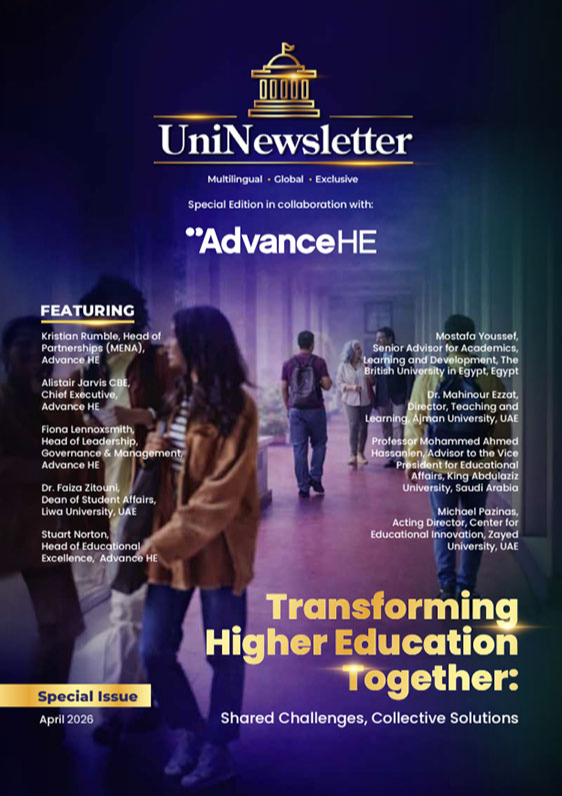
Welcome to this special Advance HE edition of UniNewsletter. The articles assembled here speak to a sector navigating rapid transformation while holding firm to its enduring purpose. Across regions and institutions, colleagues are grappling with shifting expectations, evolving technologies and the increasing complexity of the higher education environment. Yet, as this collection shows, shared commitments bind the sector together: a commitment to quality, to inclusion, to leadership and to the continual enhancement of learning.
This issue opens with reflections on the common pressures facing universities worldwide. Alistair Jarvis’ observations remind us that although contexts differ, the challenges of funding, student expectations and global uncertainty are felt across borders. His reflections highlight the importance of open dialogue, mutual learning and collaborative problem solving as institutions adapt to pressing external forces.
Leadership and organizational capability form an important thread in this edition. Fiona Lennoxsmith’s contribution emphasizes that transformation becomes possible when institutions cultivate leadership that is aligned, distributed and connected to a shared sense of purpose. Her reflections underline the need for clarity, trust and investment in developing leaders at every level.
Dr. Faiza Zitouni’s contribution foregrounds the critical role of women’s leadership in shaping inclusive and resilient institutions. Her reflections on the “She Leads” program highlight the impact of intentional development pathways that strengthen representation and embed equity within institutional culture. Her work reminds us that transformation is driven not only by strategy but by the diversity and strength of those who lead it.
Student success remains a central concern throughout this issue. Stuart Norton’s analysis shows how structured, evidence-based frameworks enable institutions to turn aspiration into sustained practice. His work reinforces the principle that meaningful transformation starts not with isolated initiatives but with coherent systems that support teaching, governance and student experience.
From here, the focus expands into professional networks and their role in shaping teaching culture. Dr. Mahinour Ezzat’s work illuminates the influence of the Advance HE Gulf Fellowship Network, demonstrating how communities of practice can amplify innovations, increase visibility of teaching excellence and strengthen professional identity across borders. Her narrative showcases transformation as a collective rather than individual endeavor.
Mostafa Youssef provides a compelling example of how strategic alignment between institutional vision, professional standards and academic development drives meaningful educational change. His reflections on the British University in Egypt highlight how teaching excellence ecosystems, grounded in the Professional Standards Framework, strengthen instructional quality and build institutional coherence.
Alongside these global concerns, deeper questions about the nature of transformation surface, with a particular focus on the impact of AI on higher education. Professor Mohammed Ahmed Hassanien’s exploration of AI ecosystems moves beyond experimentation and into systemic thinking. His work demonstrates how carefully designed tools can ease operational pressures, improve alignment with accreditation standards and enhance decision making, all while preserving the centrality of human judgment.
Meanwhile, Michael Pazinas’ exploration of AI rhetoric invites us to examine what genuine educational change entails. His argument for coherence, expert guidance and disciplinary integrity encourages a more careful and grounded conversation about how AI will shape student learning and academic practice.
Together, these contributions form a rich, interconnected conversation about the future of higher education. They ask fundamental questions about how universities adapt, whom they serve and how they uphold their values in a world of rapid change. They also demonstrate the collective strength of a sector committed to learning, reflection and purposeful progression.
As you move through this special issue, we hope the perspectives shared here inspire dialogue, spark new collaborations and support your work in shaping a more inclusive and forward-looking higher education landscape.