There were over $2.4 billion invested in advertising by higher education institutions in the first half of 2025 alone. The international student recruitment market globally was valued at $42.8 billion in 2025 and is increasing at 8.6% pa. This is not a gentle competition. This is a battle that intensifies and most universities are doing more just to stay at their position.
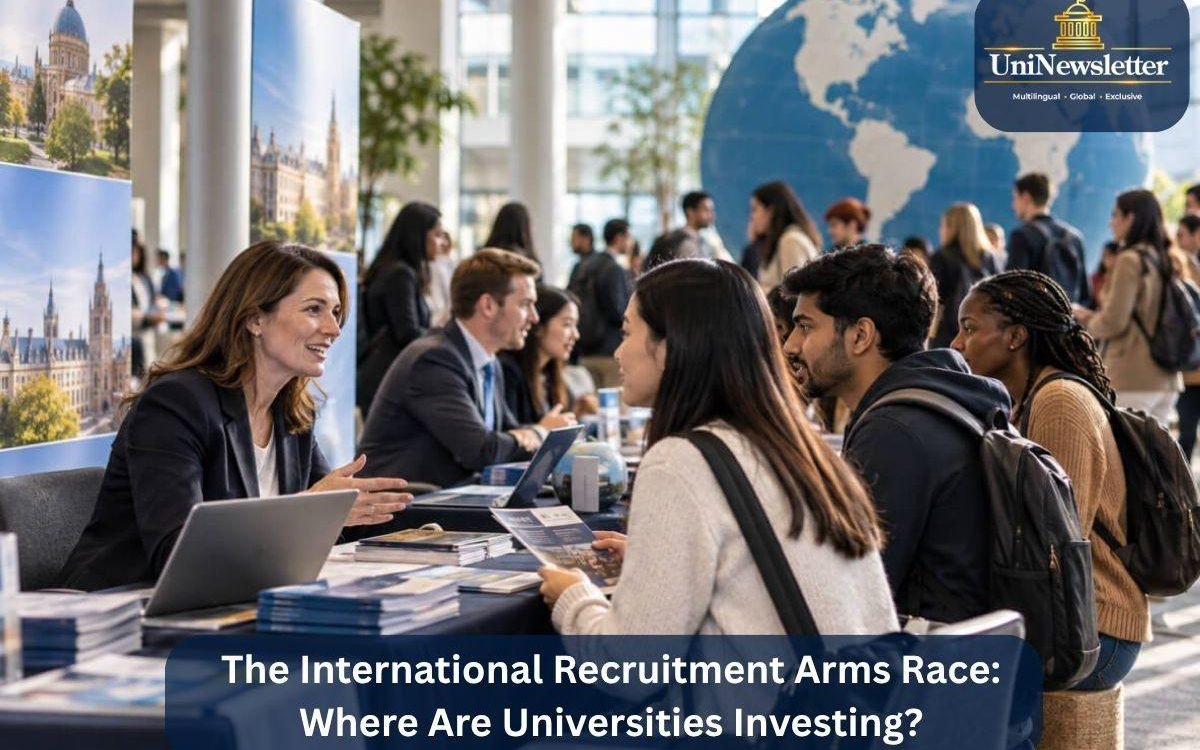
In short, when people speak about the international recruitment arms race, they’re referring to the increased investment in agents, events, digital campaigns, and in-country offices that universities have made over the past decade. However, what’s discussed less often is whether these investments are being used effectively, which strategies are generating meaningful engagement, and which institutions may simply be increasing their recruitment efforts in response to a more competitive market. At UniNewsletter, we explore these changing dynamics in international higher education and examine how universities can evaluate their recruitment strategies more thoughtfully rather than focusing solely on increasing investment.
For universities competing to attract international students for higher education in 2026, the simple question is no longer ‘how much are we spending? ‘it will be ‘what are we spending it on, and is it building on something valuable?’
What Is the International Recruitment Arms Race?
The basic dynamic is straightforward. International students pay significantly higher fees, often three to four times domestic rates in the UK and Australia. That revenue has become structurally important to how universities fund themselves. As more institutions recognise this, more of them compete for the same pool of students, driving up the cost and complexity of recruitment.
UK universities alone now spend over £180 million annually on collective marketing budgets, with digital channels accounting for 72% of that spend in 2026, up from just 42% in 2020. The shift to digital did not reduce costs. It expanded the competition into new channels that required new skills, new tools, and more budget to operate effectively.
- $42.8B Global international student recruitment market value in 2025, growing at 8.6% annually
- $40B+ Annual contribution of international students to the US economy alone
- 12.8M Students globally expressing intent to study abroad within three years, IDP/British Council 2026
Where Are Universities Investing in International Recruitment?
Spending is going in several directions simultaneously, and the mix differs significantly between institutions based on size, market position, and which regions they are prioritising.
Agent networks.
Recruitment agents remain a dominant channel, particularly for markets in South and Southeast Asia where agent relationships are deeply embedded in the student decision process. The challenge is cost and dependency. LeapBuzz 2026 university marketing guide observed that agent channel reliance should be carefully watched, and that investment in agent enablement, structured course content, scholarship resources, compliance counseling, enhances agent conversion rates at a lower marginal cost than simply increasing agent relationships.
Digital and content marketing.
Organic search generates 28-32% of qualified inquiries to UK universities for a cost per acquisition of £580–850 (SEO works 2026 education marketing data) making it the most cost effective channel for recruitment. Paid for social and search also handle awareness and retargeting costs but the pay back once a budget stops is less certain. Content that is earned in search continues to pay back even when paid search stops.
In-country offices and events.
Larger universities are maintaining or expanding in-country recruitment teams in priority markets, particularly India, Vietnam, and Nigeria. The logic is direct relationship-building that agent networks cannot replicate. The cost is substantial, and the ROI requires multi-year evaluation because relationship-based recruitment works on longer timelines than digital.
CRM and personalisation infrastructure.
EAB’s 2026 Higher Ed Marketing Outlook found that 80% of marketing leaders cite limited budget as their top barrier to enrollment goals, but the institutions closing that gap are investing in CRM and personalisation systems that make each pound or dollar of marketing spend work harder. Hyper-personalised outreach, landing pages, emails, and campaigns tailored to individual student behaviour, is increasingly standard at institutions gaining market share.
Which International Student Markets Are Attracting More Investment?
The traditional source markets, India, China, Nigeria, are not being abandoned. But the concentration risk they represent has pushed institutions to actively develop secondary markets as part of a deliberate diversification strategy.
Vietnam is the most-cited growth target for both undergraduate and postgraduate recruitment in 2026. Brazil, Bangladesh, and South Korea are also appearing more frequently in institutional recruitment priority lists. Building presence in emerging student markets requires local media partnerships and in-country knowledge that most universities are still developing, which creates an early-mover advantage for institutions willing to invest before the market becomes crowded.
The geopolitical dimension is relevant here as well. Uncertainties in policy in the US and the UK have led to increased interest from several students to the countries such as Canada, Germany, Ireland and the Netherlands. With an influx of enquiries exceeding expectation, universities there are making investments to drive conversion, a process requiring quick build up of capability in markets they had not thought of as high priority markets.
The New Recruitment Investment: Improving Conversion
One of the more interesting shifts in 2026 is where the conversation has moved. For years, the arms race was primarily about reach, more agents, more markets, more events, more digital impressions. Increasingly, the ROI conversation has moved to conversion.
Getting applications is expensive but relatively well understood. Converting admitted students into enrolled students, and keeping the students who commit from quietly choosing somewhere else before term starts, is where many institutions are finding untapped gains. AI-driven tools are beginning to change how universities manage post-offer communication and yield management at scale; personalized follow-up that was previously only feasible for well-staffed admissions offices is now accessible to mid-size institutions.
A university that converts 35% of admitted international students is effectively getting the equivalent of a 43% increase in admissions from the same application funnel, without spending another pound on awareness. Conversion investment frequently outperforms top-of-funnel spend on a per-enrolled-student basis.
Recruitment Agencies vs Direct Recruitment: Where Should Universities Invest?
This is a live debate at most institutions, and there is no universal answer. Agencies can offer market access in a timeframe that would be nearly impossible to develop directly from scratch. They have been mainly useful in markets in which relationships and personal contact are an important, if not necessarily direct, influence on student choices. The disadvantages are higher costs, the potential for inconsistent quality and the strategic liability of such significant reliance on third party contacts.
Direct recruitment, digital, organic search, alumni networks, social media, builds institutional assets over time. Social media for international student recruitment has moved from a supporting tactic to a central channel, as one recruitment director at Utrecht University put it: “Social media is no longer a question institutions ask themselves, but something they just do, because it works when done right.”
The most common effective model is a deliberate blend: agent relationships maintained and enabled in markets where they are structurally necessary, direct digital and content investment used to reduce marginal cost per enrollment over time, and in-country teams or partnerships used selectively in priority emerging markets where neither agents nor pure digital has reached maturity.
How Universities Should Measure the Recruitment Arms Race
Spending more is easy to measure. Spending better is harder but more important. The metrics that matter:
- Cost per enrolled student by channel – not cost per application or cost per inquiry. What did it actually cost to get a student through the door?
- Yield rate by source market – what percentage of admitted students in each market actually enrolled? This shows where conversion investment is most needed
- Source market concentration index – is dependency on any single country increasing or decreasing? This should be tracked as an institutional risk metric
- Organic search share of inquiries – growing organic search reduces long-term cost per acquisition; flat or declining organic share means increasing dependency on paid channels
- Agent conversion rates by agency – not just volume. The agencies generating qualified enrollments at acceptable cost are the relationships worth investing in
Is the Future of International Recruitment About Spending More, or Investing Better?
Building an international student recruitment strategy that is durable rather than just competitive requires thinking about this differently. The institutions gaining enrollment share in 2026 are not necessarily the ones outspending competitors. They are the ones that understood earlier than others that the arms race is winnable through precision, not volume.
That means investing in data infrastructure that makes every recruitment touchpoint measurable. It means building content and organic search presence that keeps generating inquiries after campaigns end. It means developing genuine relationships in emerging markets before they become obvious targets for every competitor. And it means treating the post-offer period, yield management, pre-arrival communication, conversion, as a core part of the recruitment investment, not an afterthought once the application numbers are in.
UniNewsletter helps universities create precisely this type of sustained international recruitment platform, linking your campus with potential students in new and traditional markets through media that is moving. If this is the path your campus is taking, we would love to discuss how we can offer assistance.
Conclusion
The global recruitment market is not declining. 12.8 million students are indicating the desire to study overseas within three years. The providers of education who are capturing most of the that pipeline in 2026 and beyond will be those who have stopped thinking about recruitment as a cost, and started thinking about it as a portfolio of investments, by market and by channel, based on enrolled student cost and built on assets which appreciate over time rather than channels which reset when the budget runs out.
Frequently Asked Questions
What is the international recruitment arms race?
Increasing competition between universities for international students refers to the growing rivalry among universities to recruit international students by enhanced expenditure on agents, digital marketing, in-country offices and events. Competition between institutions for the same students drives up recruitment costs and the sophistication of recruitment techniques required becomes more costly.
Why are universities increasing international recruitment spending?
International students are also high-value intakes: international fees, often three or four times of the domestic level, are far higher. With domestic student populations flattening or declining in key markets, international intakes have become structurally vital to university funding structures and increasingly valued as a result.
Which countries are universities targeting for international students?
India and China continue to be the dominant source markets in the world, but the 2026 recruitment priorities are evolving. Vietnam, Brazil, Bangladesh, South Korea, Nigeria, Ghana and Nepal are all emerging in the institution’s priority lists as universities seek to mitigate risk of over-reliance on just one or two markets.
What are the most effective international student recruitment strategies?
The most successful mixes are a tailored combination of: organic search and owned channel content (high ROI, long term); target agent relationships where they are structurally necessary; CRM and personalisation infrastructure which helps convert; and yield management to cut enrolled student loss between offer and entry. No single channel wins; the mix does.
How can universities measure international recruitment ROI?
Cost per enrolled student by channel is the most meaningful metric, not cost per inquiry or application. Alongside this, yield rate by source market, organic search share of inquiries, and agent conversion rates by agency give a clear picture of where investment is generating real enrollment versus just activity.
How can universities increase international student enrollment?
Conversion enhancement is sometimes the quickest ROI outside of top-of-funnel recruitment. Implementing improved post-offer communications, clearer financial aid messaging, offer correction in the community pre-arrival, and predictive melt monitoring can boost yield quite a bit with no extra acquisition cost.




 Featured Video