“If you fail to plan, you are planning to fail.” Benjamin Franklin said it long before anyone was running a paid social campaign to reach prospective students in Lagos or Hanoi, but it holds up remarkably well here. With 7.3 million students now studying abroad globally, according to
UNESCO’s Higher Education Global Trends Report
, a figure that’s more than tripled over the past two decades, and India having overtaken China as the single largest source of outbound students at 1.34 million in 2024 alone, higher education has never had a bigger pool of prospective international students to reach. It’s also never been
harder to actually reach the right ones. Building a genuine international student recruitment strategy isn’t optional anymore, it’s the difference between a university that fills its cohorts intentionally and one that’s still relying on hope and word of mouth.
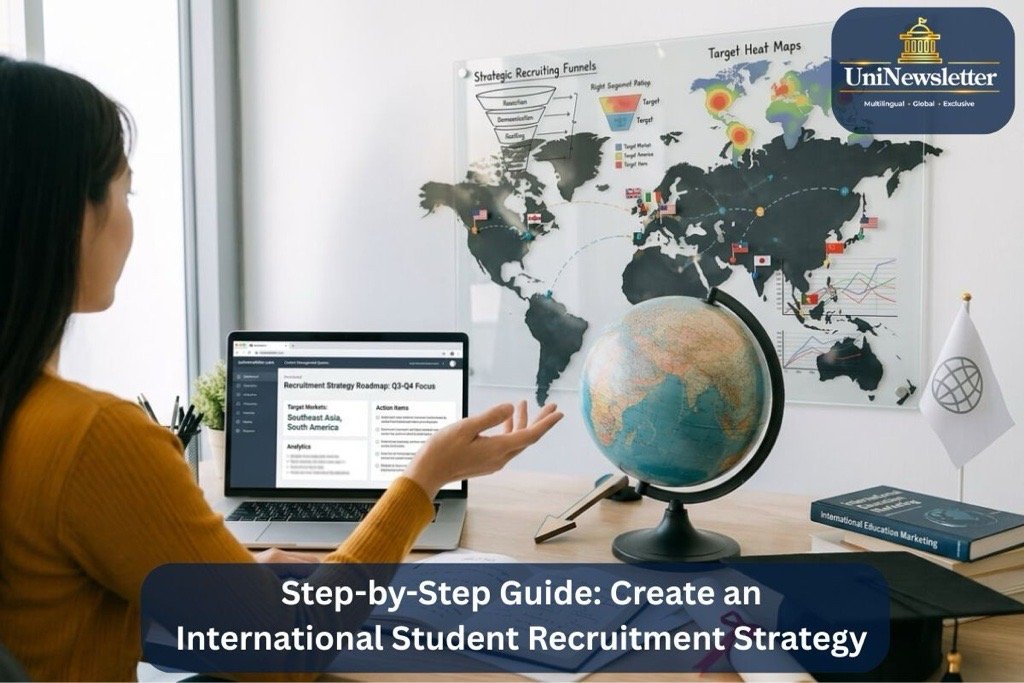
This guide shows you how to build an international student recruitment marketing plan from the ground up—step by step and based on what’s actually working across the higher education sector in 2026, not outdated advice from five years ago when the landscape looked very different. Whether you
call it an international enrollment marketing plan, a university enrollment marketing strategy, or simply higher education student recruitment done right, the core principles remain the same. At
UniNewsletter
, we closely track evolving trends in international education, student recruitment, and university marketing to provide practical insights that help institutions attract and engage prospective students in an increasingly competitive global market.
Why an International Student Recruitment Strategy Matters
The market has genuinely shifted. Traditional destinations, the US, UK, Australia, and Canada, still host well over half of the world’s international students, but their combined share is shrinking as students diversify, a trend
ICEF Monitor’s market intelligence coverage
has tracked closely through 2026. Emerging destinations like Türkiye, Egypt, and Japan are picking up real enrolment share, and Japan’s Ministry of Education is raising enrolment caps at select universities by 5% starting this year specifically to attract more international students. At the
same time, Australia has tightened visa processing and is capping international enrolments, while Indian student interest in Australia reportedly dropped 42% amid the uncertainty.
None of this is static, and that’s exactly the point. A higher education marketing plan built once and left untouched for three years is already working against outdated assumptions about where students want to go and why. Universities without a deliberate, adaptable strategy are competing
against institutions actively reallocating budget toward whichever markets and channels are actually converting right now.
Step 1: Define Your Recruitment Goals
Before you touch, even a single marketing channel, get really clear about what success actually looks like. Like, not the “big idea” version. Is it raw enrollment volume, a particular revenue target, better diversification across more source countries to reduce risk, or improved yield from the
applications you’re already getting? If the goal is something vague like “recruit more international students” then you end up with a vague strategy. But if the goal is “increase enrolments from Vietnam and Nigeria by 20% while maintaining the current yield from India” then every later
decision, budgeting, messaging, which channel to pick, has something concrete to measure against.
Step 2: Identify Your Ideal Student Personas
Every prospective person responds to a different message. A postgraduate STEM candidate from India with an existing curiosity about visas and post-studying work rights would be very different content to an undergraduate from Vietnam having their parent’s decision swayed through proxy. Develop
3-4 profiles for students with different levels of academic commitment and finance that have distinct influential actors (parent, agent, alumni) and specific worries that would prevent a ‘warm’ student from going on to apply.
Step 3: Research Target Markets
This is where outdated assumptions do the most damage. Genuine international student recruitment strategy work means going beyond “India and China are big markets” and actually tracking current mobility data, top source countries continue to include India, China, Nigeria, Vietnam, and Nepal,
but growth patterns within those markets have shifted considerably. OECD research on international student decision-making has flagged that students from emerging markets are often underinformed about actual job prospects in top destinations, a genuine content gap universities can fill
directly.
Step 4: Build a Strong University Brand
Brand reputation is often worth far more than any one marketing tactic for a university overseas. Families will conduct extensive research into rankings, outcomes, safety, campus life long before they make an inquiry. A weak or inconsistent brand can compromise any investment made later on.
Consistent messaging via your website, social channels and regional partners is more important than most institutions spend. It’s the critical final piece every push down the funnel relies on to convert.
Step 5: Create a Digital Marketing Strategy
Digital marketing for recruiting international students is nowadays a mix of various channels complementing each other rather than relying on one channel. SEO and content marketing focus on the research phase where students are gathering information. Paid social campaigns on market-specific
platforms, e. g. WeChat for the Chinese students, help in reaching the very audiences that generic campaigns fail to touch. Search ads that come in front of a student who is at the moment of choosing where to study capture them with the high-intent queries. Short-form video content is becoming
a stronger contender against static content as it follows students’ usual way of watching content.
Step 6: Implement Lead Nurturing and Marketing Automation
Most students who are planning to apply don’t change their minds after only one contact, so considering this as a one-time conversion wastes most of the contacts a university gets. A proper nurture sequence, personalized email content, timely follow-up based on where a student sits in their
decision journey, and automated triggers based on behavior, keeps a university top of mind through what’s often a 6-12 month decision process. With the help of marketing automation systems, universities can really work with a large number of leads at the same time, while the admissions
department can only do the job of following-up on the limited number of students manually.
Step 7: Leverage Student Ambassadors and Alumni
Peervoice consistently beats institution messaging by a wide margin with this group of prospects. The honest voice of a current student explaining life on campus, or an alumni’s outcome, is far more credible to a potential student than a glossy brochure. Formal ambassador programs, in which
prospective students are introduced to current students with the same citizenship or home state, and research resulting in the inclusion of the stories of successful alumni in recruitment materials both convert by a much higher margin than institution-only messaging.
Step 8: Host Virtual Recruitment Events
Virtual fairs, webinars and live Q&A sessions are still true standbys and highly effective mainly in markets where continuous participation in an actual recruitment fair isn’t feasible on a financial level. This medium also allows prospective students to actually hear the admissions staff,
current students and faculty members speak LIVE to related issues, visa questions, scholarship information and program structures that a marketing piece (pamphlet, PC slip sheet or mail drop) can’t possibly satisfy on its own.
Step 9: Measure and Optimize Performance
None of the above matters if you don’t measure it right. So you should track application starts, then application completions, and also the yield rate by source market, plus cost per enrolled student, and the channel level return on investment. After that, actually act on what the data says,
not just keep running the same campaigns unchanged year over year. Our detailed guide on
how to measure ROI for international student recruitment campaigns
goes through which metrics really matter most and how to follow them properly.
Common Mistakes Universities Make
A handful of mistakes show up repeatedly across underperforming recruitment strategies.
Keystone Education Group’s State of Student Recruitment 2026 report
, surveying over 67,000 prospective students, found a consistent gap between stated interest in studying abroad and actual enrolment, often traceable to exactly these kinds of strategic gaps.
- Treating all international students as a single homogenous audience, rather than building market-specific personas and messaging, wastes the budget on generic content nobody finds compelling.
- Relying entirely on agents without any direct-to-student marketing leaves a university dependent on third parties who don’t always prioritize any single institution’s goals over their own commission structure.
- Neglecting mobile-first content in markets where smartphones are the primary or only research device cuts off a huge share of the actual audience.
- And failing to track ROI by channel and market means the budget keeps flowing to whatever’s comfortable rather than whatever’s actually converting.
Emerging Trends in International Student Recruitment
Ai reshaping the game here with a speed hardly any other part of the university marketing world can match, universities making use of it in multiple functions together.
-
In the meantime, AI chat bots have been used to deliver the prospective student with almost any question they have, wherever they might be. At the same time, predictive analytics picks out the high-conversion leads for marketing efforts and customized content generation scales a messaging
strategy so that no admissions team could manually match.
-
Per the
current international student mobility data
the global international-education market is estimated to increase from $196 billion in 2019 to $433 billion by 2030; So, clearly showing that it’s critically important the universities are successful with this strategy implementation.
- Intra-regional mobility is growing meaningfully, with more students studying closer to home within Asia and the Middle East rather than defaulting to traditional Western destinations.
- Short-form video content continues to outperform static content in almost every region the market trends are tracked in, as per the 2007 data.
Our broader look at
top strategies universities use to attract international students
covers several of these shifts in more depth.
Conclusion
Building an effective international student recruitment strategy in 2026 kinda means treating it like a living system, not a document that gets written once, then only checked when enrolment numbers start looking disappointing. With global mobility patterns shifting towards new destinations,
and decision-making behavior becoming more research driven, plus AI reshaping how universities engage prospective students at scale, the institutions that pull ahead are typically the ones that go through these nine steps on purpose, rather than the ones with the biggest historical reputation,
coasting on inertia. For a deeper walkthrough of building this out further, our guide on
building a successful international student recruitment plan
is worth reading next, and browsing
current university trends
keeps your strategy grounded in what’s actually happening in the market right now, not last year’s assumptions.
Frequently Asked Questions
What is an international student recruitment strategy?
This is a comprehensive, data-based marketing strategy that covers goals, target markets branding, digital marketing, and measures, which is created to attract and convert prospective international students rather than just relying on ad hoc one-time outreach activities.
How can universities recruit more international students?
By combining accurate market understanding, personas-based messaging, a solid online presence, nurturing leads, and peer content like student ambassadors to support, not one single method of doing it.
Which digital marketing channels work best for higher education?
SEO and content marketing for research phase, paid social that is targeted on platforms based on particular regions, search advertising for high-intent queries, and even shorter-form video across almost every channel.
How important is SEO for university recruitment?
Much. Most applicants spend their time researching for both programs and destination countries before applying to, Because of this, universities that are well-researched on the organic part of search engines are shortlisted.
What KPIs should universities track?
Application starts/finishes, yield rate by source market, cost per student enrolled, and channel-level ROI, tracked regularly rather than looked at only after the end of a recruitment period.
How can AI improve international student recruitment?
With chatbot support that is working round the clock in different time zones, lead scoring that is predictive to prioritize high-intent inquiries, and content generation that is personalized which even at high-scale cannot be done through manual outreach.







 Featured Video