


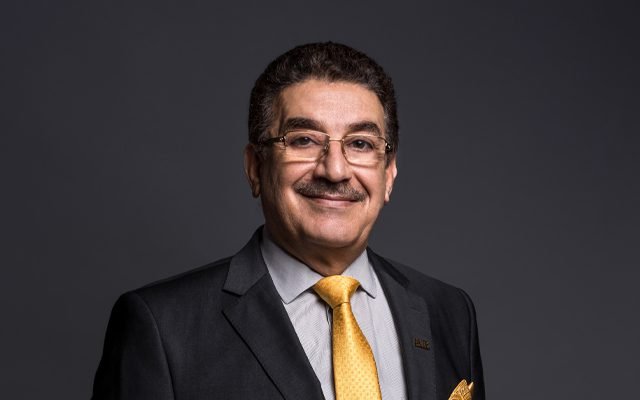
Professor Muthanna G. Abdul Razzaq, President and CEO, American University in the Emirates
Professor
Muthanna G. Abdul Razzaq, President and CEO, American University in the
Emirates
1. Professor Abdul Razzaq, thank you for joining us for this edition of UniNewsletter. To begin, could you share
your journey in higher education and what led you to establish the American University in the Emirates?
My journey has always been guided by a profound belief that education is the most sustainable investment any nation
can make. Economies rise and fall, and technologies continue to evolve, but the true wealth of every country lies in
the quality of its people.
After completing my PhD in Management Accounting at the University of Manchester in the United Kingdom, I dedicated
my career to advancing higher education across our region. I have always believed that universities should do more
than transmit knowledge. They should create opportunities, inspire innovation, develop ethical leaders, and
contribute directly to national development.
That vision led me to establish Abu Dhabi University in 1999, the American University in the Emirates (AUE) in 2005,
and later the American University in Kurdistan in 2012. Although each institution serves a different community, they
share the same mission: to provide internationally recognized education while responding to the aspirations and
needs of society.
When I founded AUE, my objective was not simply to establish another university. My ambition was to build an
institution where academic excellence, innovation, international collaboration, research, creativity, and industry
engagement would become part of its DNA. Nearly twenty years later, seeing our graduates lead organizations, launch
businesses, shape public policy, serve their communities, and create positive change remains the greatest measure of
success.
2. You established AUE at a time when the higher education landscape in Dubai was still evolving. What did you see
then that others had not yet recognized?
I saw that Dubai was preparing to become one of the world’s leading knowledge economies. At the time, many
universities understandably focused on delivering degree programs. I believed universities should become strategic
partners in building nations and that higher education should anticipate the future rather than react to it.
That meant creating programs before industries demanded them, investing in international accreditation before it
became expected, embracing digital transformation before it became essential, and developing graduates capable not
only of finding employment but also of creating opportunities for others.
Perhaps the most important question we have consistently asked ourselves is not, “What do students need today?”
but, “What kind of leaders will the world need tomorrow?” That question continues to shape every strategic decision
we make.
3. Over the years, how has your leadership approach evolved, and what principles continue to guide you in leading
an institution such as AUE today?
Leadership evolves because institutions evolve. In the early years, leadership required building campuses,
establishing systems, recruiting talented faculty, developing academic programs, and earning credibility. Today, it
is much more about empowering people than managing processes.
No president builds a great university alone. Great universities are built by talented people united by a common
purpose. My leadership continues to be guided by five principles: students are always our reason for existing;
academic quality must never be compromised; innovation is not optional but essential; people are more important than
processes; and optimism is a strategic asset.
Throughout my life, I have believed in one simple philosophy: nothing is impossible. Every university, program,
partnership, and achievement begins with someone believing it can be accomplished.
4. AUE offers a number of distinctive programs that are not widely available in the region. Could you share how
one of these programs came to life, from identifying a gap to launching it successfully?
Innovation rarely begins in a meeting room. It begins by listening. We listen carefully to government leaders,
employers, industry experts, alumni, international partners, and our students. We examine demographic changes,
technological developments, labor-market trends, and national priorities. Only then do we begin designing academic
programs.
Our expansion into specialized graduate and doctoral education illustrates this philosophy. As the UAE continues to
build a knowledge-based economy, there is increasing demand for researchers, executive leaders, policy specialists,
innovators, and professionals capable of solving complex challenges.
Rather than replicate existing programs, we strive to create curricula that combine academic rigor with practical
relevance, interdisciplinary thinking, research excellence, artificial intelligence, leadership development, and
real-world engagement. Every new program must answer one important question: will it improve lives and contribute
meaningfully to society? If it does, it deserves to exist.
5. You have introduced initiatives such as the Centre for Peace and Conflict Resolution and the Debate Centre.
What role do these initiatives play in shaping the culture and identity of the University?
Universities should educate the whole person. Professional knowledge alone is no longer sufficient. Tomorrow’s
leaders must also understand dialogue, empathy, ethics, intercultural understanding, diplomacy, critical thinking,
and responsible citizenship.
The Centre for Peace and Conflict Resolution reflects our belief that sustainable development requires peaceful
dialogue and mutual understanding. Similarly, the Debate Centre develops confidence, analytical thinking,
evidence-based reasoning, and respectful communication.
Leadership begins with character. Technical competence may secure a position, but character determines whether
someone becomes an effective leader.
6. Students today come from increasingly diverse backgrounds and experiences. In your view, how have their
expectations evolved, and how should universities respond?
Today’s students are entering a world that is changing faster than any previous generation has experienced.
Artificial intelligence, automation, digital transformation, sustainability, entrepreneurship, and globalization are
reshaping every profession.
Students therefore expect universities to prepare them not only for employment but also for continuous adaptation
throughout their careers. Higher education must become increasingly flexible, interdisciplinary, technology-enabled,
globally connected, and student-centered.
Universities should not fear artificial intelligence. They should teach students to use it responsibly, ethically,
creatively, and intelligently. The university of the future will no longer be defined primarily by its buildings. It
will be defined by its ability to help people continue learning throughout their lives.
7. Looking back, what is one aspect of AUE that you are most proud of that may not always be visible to the
public?
People often see rankings, accreditations, buildings, laboratories, graduation ceremonies, and academic programs.
What they do not always see is culture, and culture determines everything.
Over nearly two decades, AUE has built a culture grounded in integrity, collaboration, innovation, mutual respect,
accountability, and continuous improvement. I am particularly proud that many members of our academic and
administrative community have remained with the University for many years because they genuinely believe in its
mission.
Buildings can be constructed within months. Culture takes decades. That culture is, without question, our greatest
achievement.
8. Finally, what advice would you offer to the next generation of academic leaders who aspire to build meaningful
and lasting institutions in higher education?
Never establish a university simply to award degrees. Build an institution that changes lives. Remember that every
student represents a family’s hopes, a nation’s future, and society’s potential.
Academic leadership requires patience, courage, resilience, integrity, humility, and an unwavering commitment to
excellence. Never compromise quality. Never stop learning. Never lose sight of your purpose. Most importantly,
invest in people, because institutions become great only when their people become great.
Throughout my career, I have been guided by the belief that education is humanity’s greatest long-term investment.
Universities do far more than prepare graduates for employment. They shape the leaders who will guide governments,
businesses, scientific discovery, healthcare, media, education, and society itself.
If I could leave one message to future academic leaders, it would be this: dream beyond today’s possibilities. Build
institutions that outlive you. Lead with integrity. Serve with humility. And remember that excellence is never a
destination; it is a lifelong journey.